We get all kinds of questions about our RVing FuseSwitch™ Here is a video showing you how to install the RVing FuseSwitch yourself. As always, if you have any questions, feel free to Contact Us.
---
Like what you've just read?
Tell your friends on facebook or twitter!
Tweet


Tuesday, July 26, 2011


Monday, July 18, 2011
TECH TWEET: What type of wiring connection should I use?
4 Wire Versus 6 Wire Connections:
Q: When we are setting up a vehicle for towing we often hear: You recommend 6 wire connectors. The
other dealer specified a four wire connector. What gives?
A: Most towed vehicles require 4 wires for their lighting requirements however there are other power requirements. The lighting is as follows: (with the color code in brackets):
Right Signal and Brake (green),
Left Signal & Brake, (yellow)
Tail‐lights (brown)
and Ground (white).
The majority of wiring kits include what is known in the industry as flat four trailer wiring which is a flat cable with four colored wires moulded into a single strip. (See photo)

For a vehicle lighting requirements and for light‐weight utility trailers that do not have electric brakes, this type of wiring is fine. It was adopted by the RV industry when RVers first decided to tow small cars about twenty years ago.
Needs have changed:
Today, towing systems are more sophisticated with most RVers regularly towing a vehicle equipped with a Towed Vehicle Braking system. Some even require a charge line. With Four Wire connectors, you are out of connections. For this reason six wire connectors are the industry norm today. Another reason to
adopt a six wire system is that the type and quality of connectors is vastly superior. As the two photos show, the black six wire connector is far more substantial with larger pins capable of carrying higher current loads
than the smaller chrome four wire connectors.
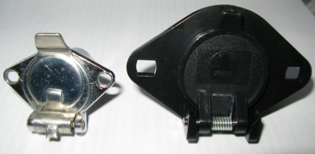

The six wire connector is polarized so that the plug in part can only go in one way, even if forced into place. There is better water infiltration protection from a large boot rather than a grommet.

The RV industry has acknowledged that RVers may tow a larger trailer or a Towed Vehicle behind what are much larger RV’s than were the norm 20 years ago. The industry has
adopted a standardized seven pin blade style receptacle (see photo) so that trailers, which come with male ends designed to mate to these connectors, can be plugged right in.

All the lighting, braking and charge wiring is accommodated with a seven pin blade connector. Towed Vehicles usually do not require a charge line, so one wire connection can be eliminated and six wires will provide all the functionality required. The industry has responded with a round plug in adapter, which can be readily obtained. It is simply plugged into the coach connector and the cable extension is plugged into it, to provide all the functionality required. (See Photos)


Should a Charge line be required, many adapters have the capability of allowing one
wire to be moved to provide 12 volts from the Coach connector to the tow car.
RV manufacturers frequently use relays for all of the lighting functions to ensure that full power is available to the trailer or Towed Vehicle. This, when combined with a much more substantial connector, means the lighting on the towed vehicle is brighter and will be clearly visible under all towing conditions.

The Extension cable between the RV and the Towed Vehicle should be a coiled style to greatly reduce the risk of it being damaged when turning or crossing uneven terrain. The cable will stretch out or contract depending upon the need and should never drag on the ground or get caught under the tow system. This style of cable also allows for Drop/Riser receivers and other towing accessories to be installed in the towing system while maintaining the wiring above the tow system.
Conclusion: Always Go with the 6 Wire Tow Electrical Connections.
(This post is also available in an easy to read PDF format. Contact Us and ask for this Tech Tweet by telling us that you would like a copy of the Tech Tweet "What Type of Wiring Should I Use?")
---
Like what you've just read?
Tell your friends on facebook or twitter!
Tweet
Friday, July 15, 2011
Tech Tweets Coming Soon
As we work to improve our web presence, we're going to be launching a Tech Tweets section on our blog. We hope that you will find these quick tips to be practical and helpful. Our Tech Tweets will go well beyond the typical tweets that can be found on Twitter. You'll find that the title for these tweets will be made available on Twitter as soon as we have them up on the blog. So if you want to follow our Tech Tweets, try following us on Twitter for up to the minute updates!
---
Like what you've just read?
Tell your friends on facebook or twitter!
Tweet
---
Like what you've just read?
Tell your friends on facebook or twitter!
Tweet
Tuesday, May 24, 2011
Spartan Chassis Plant Tour (Part 3)
One of the last items on the tour, (besides the military division where we did not have access) was the production of Isuzu “small” chassis equipped with gasoline engines. These are similar to the ones GM built prior to their reorganization. All gas engine chassis have a Spartan frame rail and body and a GM power train. The plant is running overtime to keep up the production. Some are being converted to run on natural gas or propane and EPA testing is currently underway for certification. There is no doubt that this mode of transport will become very popular with tradesman and delivery companies. There was even a crewcab model which is popular with landscapers so that they can take their crew along to the jobsite. Ultimately the hope is that they will be able to build the diesel models currently made in Japan and shipped to North America. Spartan is also shipping fire trucks to China and has begun training there as well. It looks like the economy is slowing coming back in the USA and the various interests they have developed in emerging economies will ensure this company prosper and grow in their southern Michigan location.
Owner as well as technician training is available in the extensive training facility located in Plant one (the service center) This four day course shows the owner the many subassemblies on a typical coach as well as how various components operate and are serviced. In addition a complete walkthrough of your coach is included with many helpful hints and techniques provided to make the owner experience even better.
All in all, this tour was a very informative and encouraging one. -- R.L.
This is part 3 of a 3 part series
---
Like what you've just read?
Tell your friends on facebook or twitter!
Tweet
A Surprise Encounter at Wakarusa, Indiana

While staying in Elkhart, IN prior to attending the Family Motor Coach Association’s (FMCA) Great Lakes Area Spring Spree (G.L.A.S.S.) Rally, I took a short trip to Wakarusa, IN home to a large Monaco production complex. While in the downtown area I heard the whine of an electric vehicle slowing down. I looked up to see a unique, white van approaching the stoplight. As it pulled around the corner, the unmistakable whine of an electric powertrain could be heard. I recalled that there had been plans to produce electric vehicles in the Elkhart area and recalled seeing a very new RV dealership facility that had been closed in the downturn with plans to reopen it as a sales store for electric vehicles. As I drove over in the direction of the dealership, I wound my way through the Navistar/Monaco production complex. It was obvious that towables and Class C RV’s were being built to meet the new market demand.

As I approached the dealership, I saw a number of the vans similar to the one I had seen on the road. A portion of a Navistar plant was obviously producing these vehicles. They were white with distinctive black accents, taller than the typical “North American” full sized van (similar in height to the European designed Mercedes/Freightliner model). Their width was about ⅓ narrower, featuring a large windshield and single wiper. The front end was distinguished by a very modern looking, swooping fascia with projector style lighting set in a black accent panel. Ample black panels accented the body look. The single entry door was on the curbside and a rear rollup door was in the rear. All in all it was a very stylish, functional design.

With my mind spinning about how this could be utilized to create a unique class B RV, I drove past this facility to the dealership which was completely fenced off, although all of the signage was still on the building and on a street side sign. It was being offered for “For Lease”. Changes in the market are slowly working their way through, with early adopters becoming casualties of change, yet there are glimmers of hope for a bright future showing up.
My trip so far has allowed me to see some unique, smaller, purpose designed trucks which will run on LP gas (propane), Natural Gas, and electricity. Can a “green“ RV be far behind? We’ll keep following this trend. -- R.L.

Like what you've just read?
Tell your friends on facebook or twitter!
Tweet
Spartan Chassis Plant Tour (Part 2)

Those chassis do have a number of wiring connections designed to mate with body components. Each RV maker has a location for their wiring looms and air brake hoses. Fleetwood has it mounted along the road side upper chassis rail accessible from the bin areas in the finished RV. Newmar has that harness run much closer to the outer edge of the central chassis structure which will be accessible from covers placed along the bottom of the chassis. Spartan does supply and install jack systems however each RV maker selects whether to use the Spartan supplied system or the one they supply to Spartan to install.
The bare chassis allows one to get a good view of the additional components required to meet the 2010 emission standards. With the additional “muffler”, the tank for the Urea additive and the computer equipment needed to operate and monitor the system take up at least the space for one exterior compartment.
Quality production is evident and to further aid in field diagnosis of problems our tour leader is championing a project to photo document each chassis model. This will be stored on line and available to those doing service in various forms. What he has discovered from this project is that installing components on a bare chassis from the top and bottom and then having to document it (and service it) when the chassis in under a RV body highlights the difficulty a technician has in servicing it. The natural and logical upshot of this project is “can we do it differently to make the component accessible in the finished RV?” Certain this project will drive better service and product improvements which will make it less expensive to service.
--R.L.
This is the 2nd of 3 parts.
---
Like what you've just read?
Tell your friends on facebook or twitter!
Tweet
Monday, May 23, 2011
Spartan Chassis Plant Tour (Part 1)

This is the 1st of 3 parts.
Click here to go to Part 2
Click here to go to Part 3
---
Like what you've just read?
Tell your friends on facebook or twitter!
Tweet
Subscribe to:
Posts (Atom)